HIRO
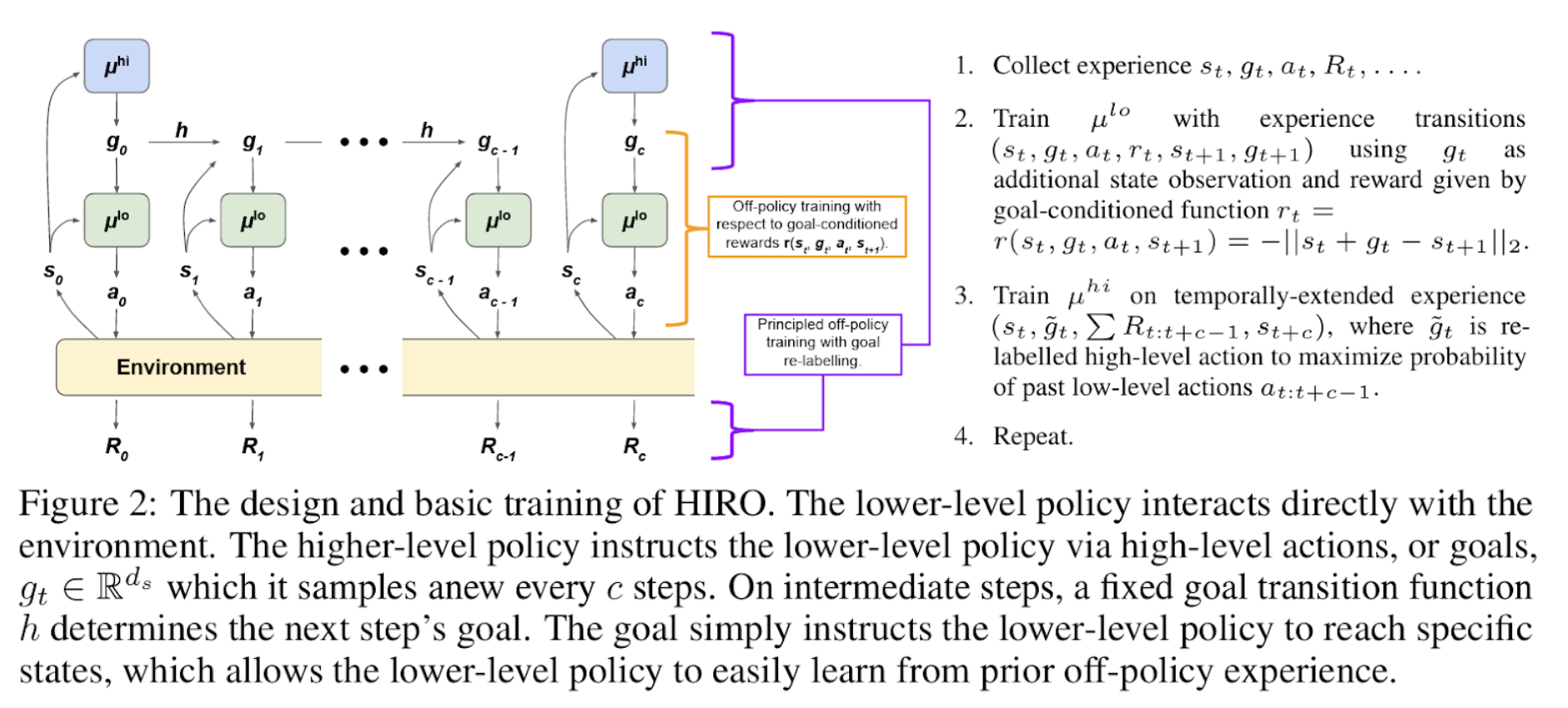
HIRO, short for Hierarchical Reinforcement Learning with Off-Policy Correction, makes the subgoal idea more scalable. The agent is split into two policies: a high-level policy chooses a subgoal , and a low-level policy takes primitive actions to reach that goal. Every steps, the high-level policy updates the goal.
The difficulty is off-policy replay. The replay buffer contains old goals from older versions of the high-level policy, but the low-level policy may have changed. Old data no longer matches new behavior, so the high-level policy can become confused.
HIRO corrects this mismatch by relabeling the stored goal with a goal that explains what actually happened:
In words: what goal would have produced the observed low-level behavior?
Equation walkthrough
HIRO fixes stale goals in replay
Click each equation to see how HIRO separates high-level subgoals from low-level actions.
Goal relabeling
what goal explains the observed behavior?
HIRO replaces stale stored goals with a goal that approximately matches the state change the low-level policy actually produced.
A corrected goal used for off-policy training.
The state before the low-level policy executed for k steps.
The state after k low-level steps in the replayed trajectory.
Why does HIRO relabel goals in the replay buffer?