DreamerV3
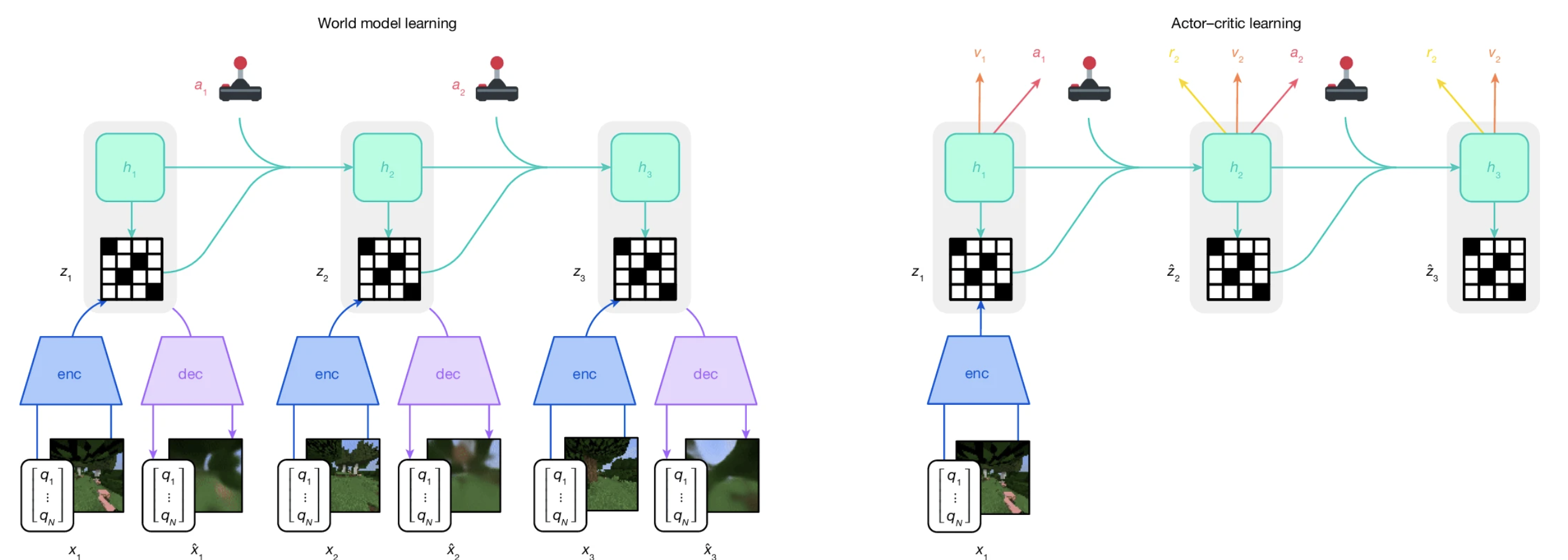
DreamerV3 keeps the core Dreamer idea, but makes the world model more explicit and scalable. It separates recurrent memory, stochastic discrete representations, prediction heads, and actor-critic learning so the agent can train across visually complex domains with one coherent latent model.
For each timestep, an encoder maps sensory input to a representation , a recurrent sequence model maintains state from past actions, and the concatenation of and forms the model state used to predict reward, continuation, and reconstructed inputs when needed.
Equation walkthrough
DreamerV3 model components
Click each component to see how DreamerV3 builds and trains a latent world model.
Sequence model
Encoder
Dynamics predictor
Reward predictor
Continue predictor
Decoder
Sequence model
memory from past latent states and actions
The recurrent sequence model updates deterministic state h_t from the previous recurrent state, previous latent state, and previous action.
Pieces
Equation walkthrough
DreamerV3 world-model loss
Click each term to see how DreamerV3 balances prediction, dynamics, and representation learning.
Model objective
total DreamerV3 world-model loss
DreamerV3 trains the world model by minimizing a weighted objective over time, with terms for prediction, dynamics, and representation learning.
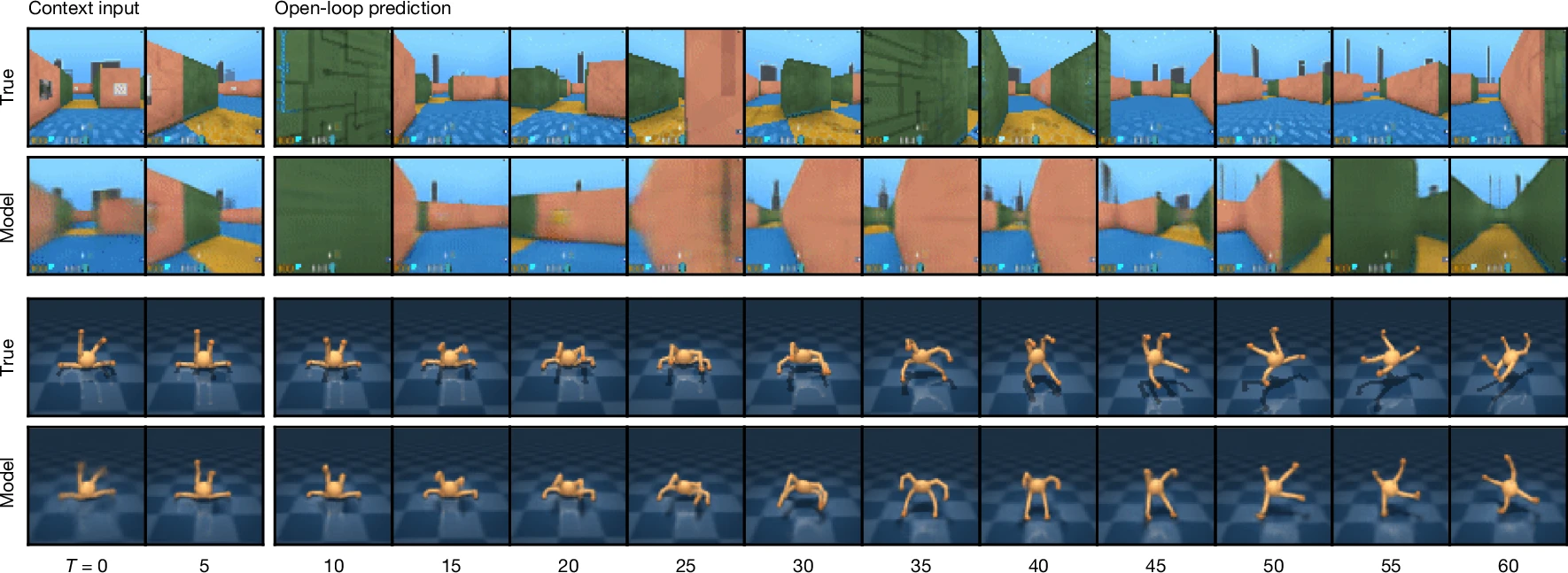
Earlier reconstruction-heavy world models had to reproduce visual details such as noise, backgrounds, and textures. Those details can make long-horizon imagination drift, and not all visual information is useful for control.
DreamerV3-style systems put more pressure on latent consistency, reward prediction, value learning, and continuation prediction. For each timestep, an encoder maps sensory input to a representation , a recurrent sequence model maintains state from past actions, and the concatenation of and forms the model state used to predict reward , continuation , and reconstructed inputs when needed. Image encoders and decoders are usually convolutional networks; vector inputs often use MLPs; categorical latent variables can provide a compact discrete internal state.
Which set best describes the DreamerV3 world model components?