Decision Transformers
Decision Transformers approach offline RL from a different angle: if we know what return we want, can we predict the actions that tend to get there using a supervised sequence model? Instead of learning a Q-function and maximizing it, the model conditions on a desired return, the past states, and the past actions, then predicts the next action.
This reframes RL as conditional sequence modeling. The dataset becomes a supervised training set: when the remaining target return was high and the agent saw this state history, this action came next. The model learns patterns in successful trajectories without explicit TD bootstrapping, value functions, or Q-maximization over unseen actions.
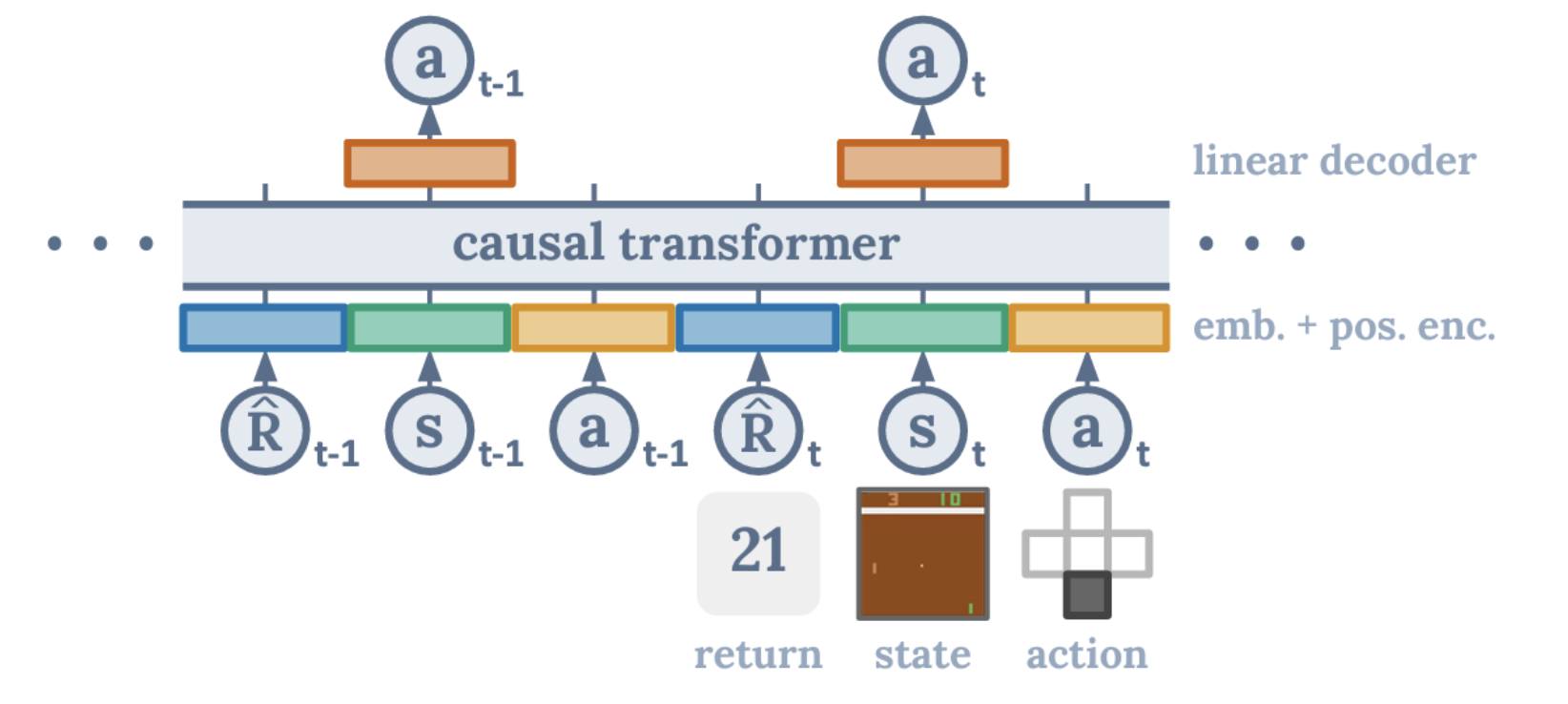
A Decision Transformer trains on token sequences such as
The model learns
or, as a likelihood objective,
The architecture is usually a causal transformer: masked self-attention only, no encoder half, and each token can attend to past tokens but not future ones. In other words, the model tokenizes decisions and predicts the next action autoregressively.
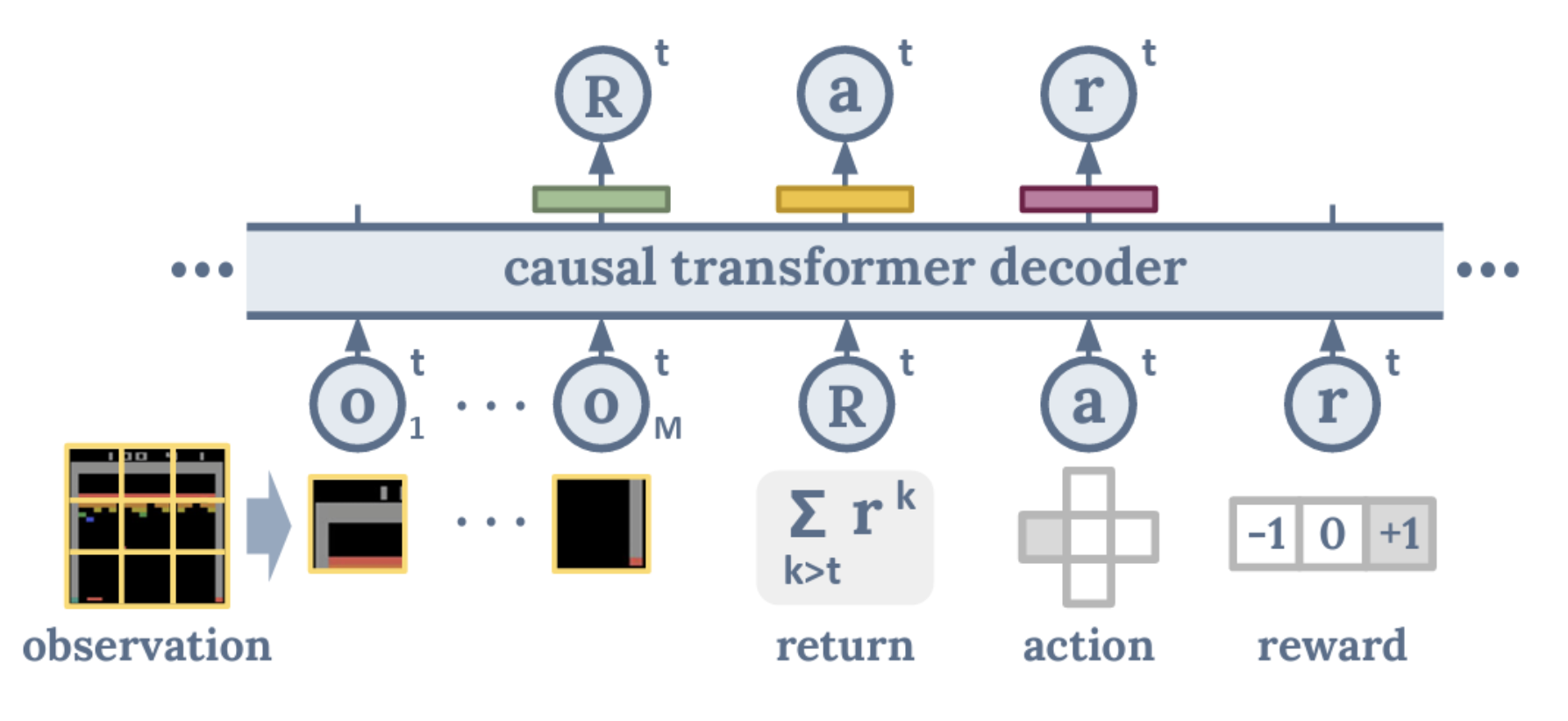
At inference time, the loop is simple:
Step 1
Set target return
Choose the return you want the trajectory to achieve, such as .
Step 2
Predict action
Use return, current state, and history to predict the next action.
Step 3
Environment responds
The action produces the next state and reward.
Step 4
Update and repeat
Adjust the remaining target return, append the new context, and continue.
This can feel like "RL without RL": the training objective is supervised action prediction, but the conditioning variable lets the user ask for higher-return behavior when the dataset supports it.
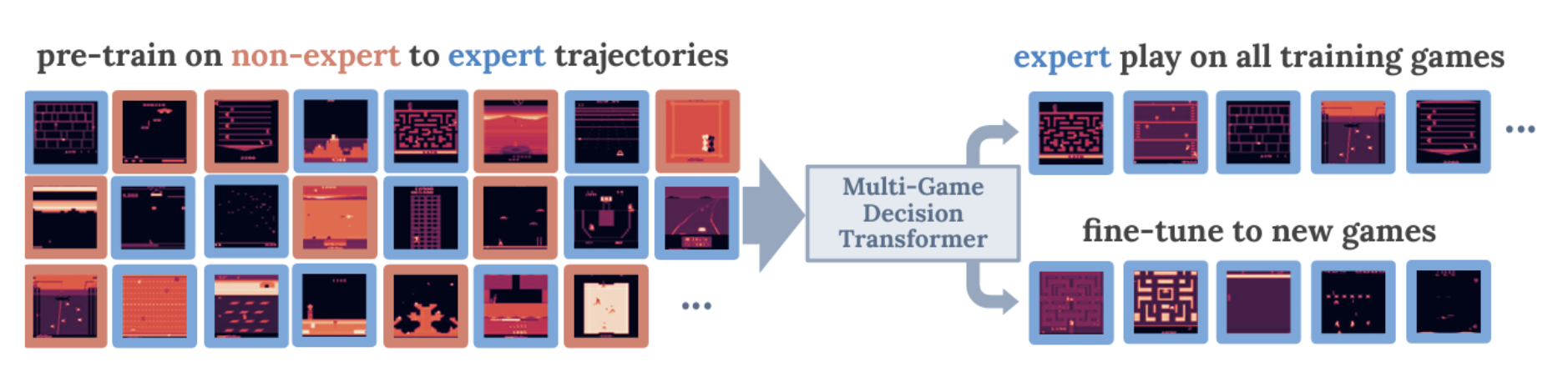
The limitation is still coverage. If you ask for a return higher than anything in the dataset, or for behavior in states the dataset barely covers, the transformer is also extrapolating. Decision Transformers avoid one failure mode of Q-learning, but they do not make unsupported deployment safe.
When Decision Transformers Shine
They are most natural when you have large trajectory datasets with varied returns: game play traces from experts and non-experts, robot logs across many tasks, navigation data with different path qualities, or simulated rollouts covering many styles of behavior.
Method comparison
Choose the offline RL tool
Select a method to compare what signal it uses, how it handles unsupported actions, and when it is most natural.
Selected method
CQL
CQL still learns Q-values, but it pushes down unsupported optimism so the policy does not chase actions the dataset cannot justify.
Uses rewards?
Yes
Handles OOD actions?
Strongly.
Strength
Conservative Q-values.
When to use
Mixed datasets where Q-learning may overrate unsupported actions.
What does conditioning on desired return do in a Decision Transformer?