Actor-Critic Methods
REINFORCE uses raw returns, and raw returns can be noisy. Some trajectories start in lucky states. Others start in difficult states. A high return does not always mean the chosen action was especially good; it may mean the situation was already easy.
Actor-critic methods add a second learner. The actor is the policy that chooses actions. The critic estimates how good a state usually is, often as . The critic acts like a baseline, so the actor can ask a fairer question: was this action better or worse than expected?
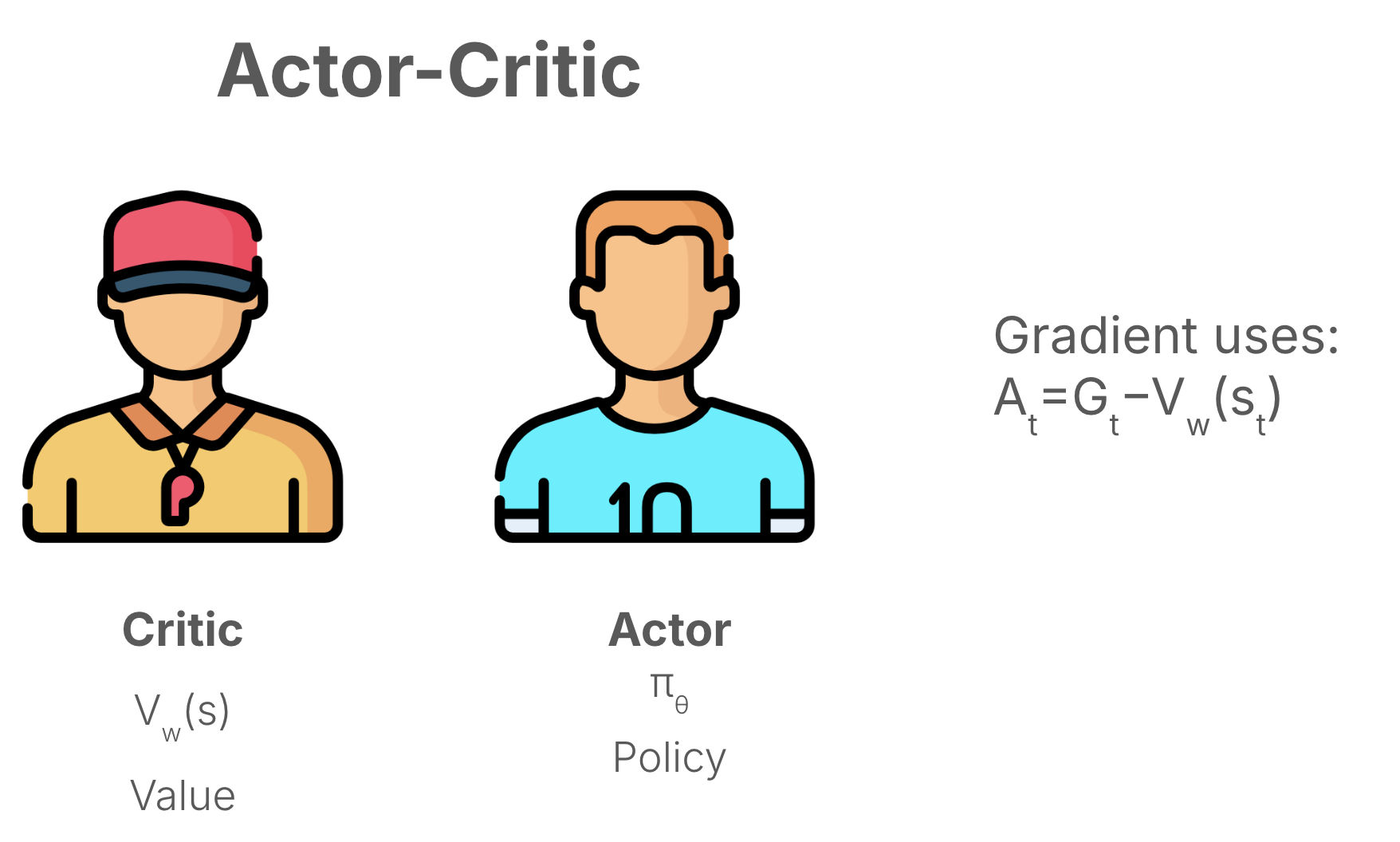
Actor-critic
Judge the action relative to what was expected
Choose a situation. The critic's baseline controls for whether the state was already easy or hard.
Return Gt
4
Critic V(st)
1
Advantage At
+3
The simple actor-critic advantage estimate is
≈
If , the sampled action did better than the critic expected for that state, so the actor should make it more likely. If , the sampled action did worse than expected, so the actor should make it less likely.
This connects back to the value-function chapter: is a sample of , and is the expected return from the state before choosing the particular action. Their difference is the advantage: .
Where GAE Fits
Generalized Advantage Estimation smooths this feedback over time. Its parameter controls memory: uses short, steadier feedback; uses longer credit assignment with more variance.
Was it more difficult to remember today's breakfast or your breakfast two weeks ago? Credit assignment has the same shape. The farther back a consequence stretches, the harder it is to decide which action deserves credit.
Memory decay is controlled by . Higher means the advantage estimate keeps more context from later timesteps, but it also admits more variance. Lower means shorter memory, steadier updates, and more bias toward immediate feedback.
In A2C, the critic can give a single snapshot of how good a state is. But sometimes feedback should stretch across multiple timesteps. Generalized Advantage Estimation, or GAE, smooths that feedback by blending short- and long-term memory.
TD error
What surprised the critic?
GAE starts from a one-step critic surprise, then lets that surprise echo forward through time.
Critic surprise
what changed after acting
The temporal-difference error measures how surprised the critic was once it saw the reward and the next state.
Pieces
GAE starts with the critic's one-step surprise:
Here is what we thought this state was worth before acting, is the actual reward received now, and is what we expect the future to be worth. Then GAE averages recent surprises, weighted by memory decay:
Generalized Advantage Estimation
Memory decay controls how far feedback stretches
Was it easier to remember today's breakfast or your breakfast two weeks ago? GAE uses lambda as a memory knob for recent critic surprises.
Weighted recent plays
AtGAE = 2.66
Context kept
75%
Variance
higher
Bias
medium
Low lambda
Steady, but forgetful. It mostly trusts short-term critic surprises.
High lambda
Captures distant consequences, but adds noise from longer rollouts.
measures how much better or worse an action was compared to what the policy expected at that state. If , the action was better than expected. If , it was worse than expected.
The tuning question is bias versus variance. As , GAE captures longer-term consequences, but adds noise. As , GAE is steadier and lower variance, but more forgetful. GAE lets us blend the two smoothly.
Why does subtracting a critic baseline help policy learning?