Policies as Trainable Objects
Value-based methods learn a map from situations to action values. DQN asks, "how good would each action be here?" Policy-gradient methods start from a different instinct: do not learn the whole value map first; directly tune the chooser.
A policy is written , the probability that a policy with parameters takes action in state . In a discrete task, the policy might output probabilities for left, right, and wait. In a continuous-control task, it might output a steering angle or a distribution over motor commands.
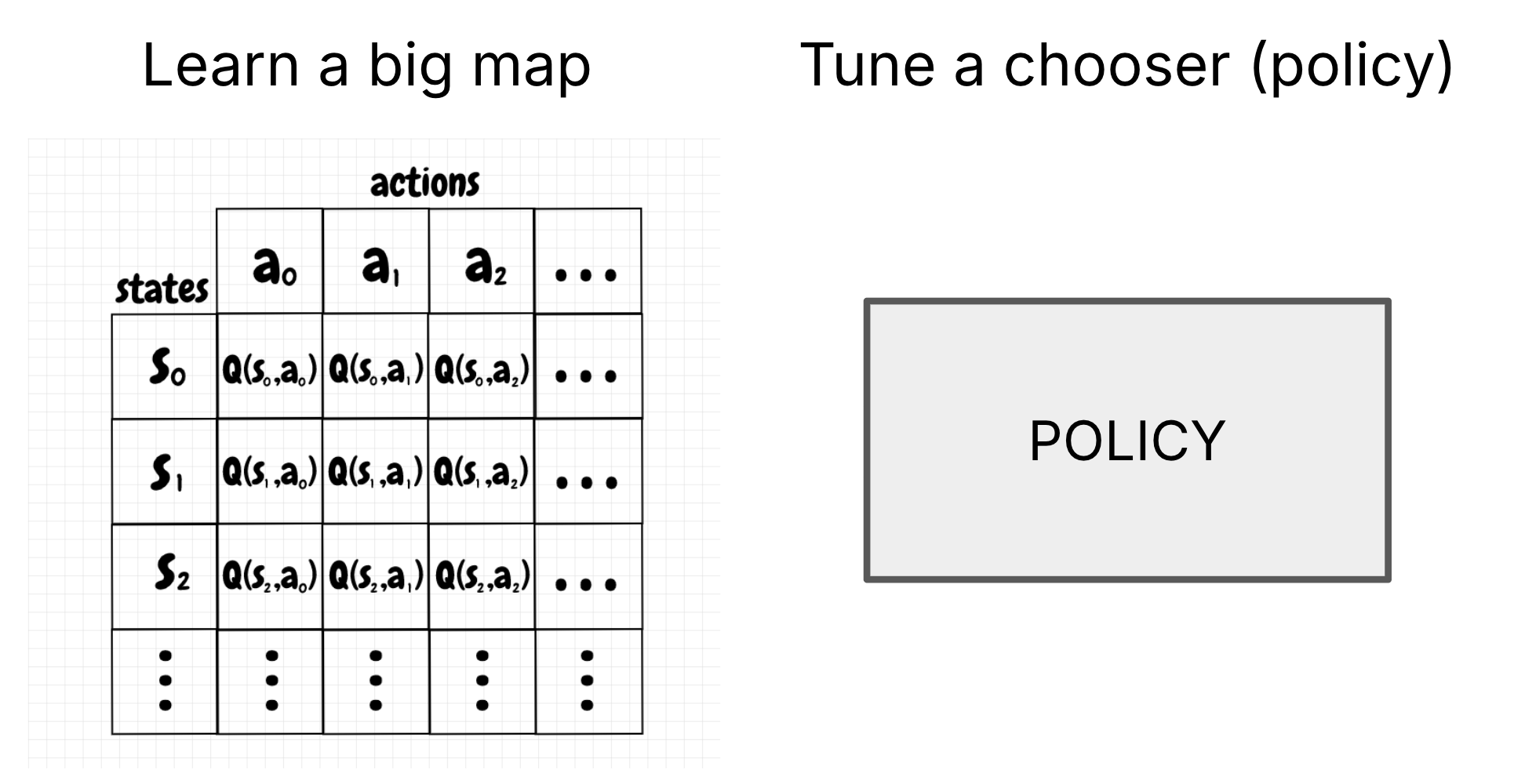
Policy gradients
What is the model learning?
Use the same state. Switch representations to see the difference between learning action values and learning the chooser directly.
State
A robot is one step from a charging dock. It can move left, move right, or wait.
Output the chooser directly
The objective is expected return under the current policy:
Here is a trajectory generated by following the policy, and is the return from the start of that trajectory. Training changes so trajectories sampled from tend to receive higher return.
Why Direct Policy Learning Can Feel Natural
If the action is continuous, such as a steering angle, scoring every possible action is awkward. A policy can directly output a useful action distribution instead of enumerating an enormous action list.
What does mean in a policy-gradient method?