Curiosity-Driven Learning
Curiosity-driven learning gives the agent an intrinsic reward for discovering something, even before the task reward appears. This is useful when external reward is rare. A robot might need to learn what a door handle does before it can ever receive reward for reaching the next room.
The hard part is deciding what should count as discovery. Novel pixels, prediction error, state counts, and information gain can all be used as curiosity signals, but they do not point to the same behavior.
Intrinsic reward
Curiosity can help or distract
Pick a curiosity signal for an agent that needs to open a door. One part of the room is useful but unfamiliar; another is noisy forever.
Likely target
Noisy screen
Unpredictable noise keeps producing error, so the agent can be rewarded for staring at something irrelevant.
A common decomposition writes the learning signal as an external task reward plus an intrinsic bonus:
The coefficient says how much curiosity matters relative to the real task. If is too small, curiosity may not overcome sparse reward. If is too large or poorly defined, the agent may optimize curiosity itself instead of using curiosity to find task-relevant evidence.
Intrinsic reward methods
Choose the signal behind curiosity
Each method turns a different kind of novelty or uncertainty into an intrinsic reward. Click a method to inspect what it measures.
ICM
Intrinsic Curiosity Module
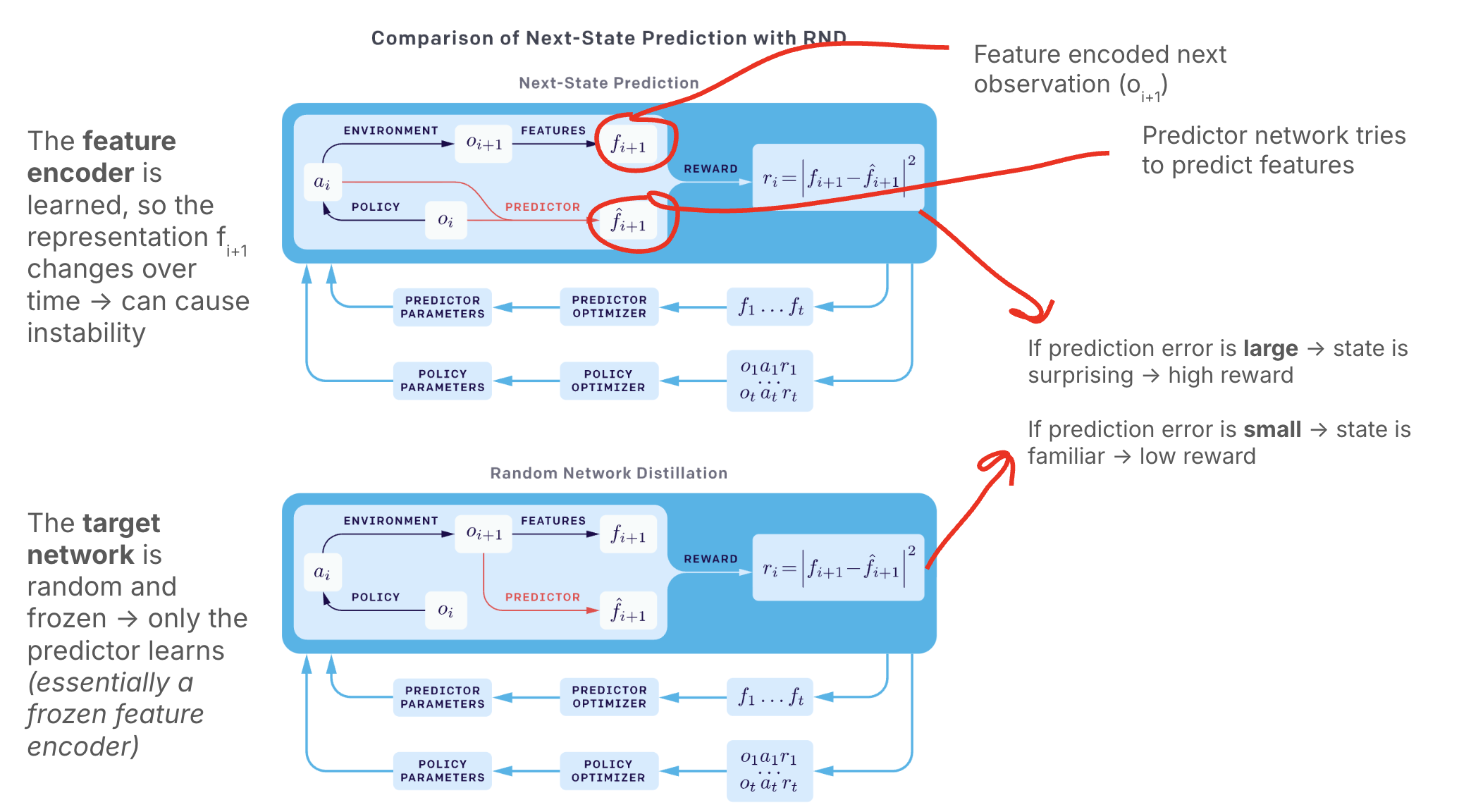
Forward-model prediction error in feature space.
Equation
intrinsic reward at time t
learned feature embedding of the current state
predicted next-state embedding
forward model with parameters eta
action taken by the policy
squared prediction error, usually using Euclidean distance
Good fit
Structured environments where the agent can learn controllable transition dynamics.
Watch out
Raw prediction error can chase noise if the representation is too close to unpredictable pixels.
The Noisy-TV Trap
Prediction error is not always useful information. A source of random noise can remain unpredictable forever, so a prediction-error bonus can reward the agent for watching noise instead of learning controllable structure.
Without noisy TV
With noisy TV
Episodic memory
How an episodic curiosity module creates a bonus
Click each component to trace how the current observation becomes an intrinsic reward and, when novel enough, gets stored in memory.
Selected component
Memory buffer
Episode memory
Math handle
Role in the module
The buffer stores embeddings of states the agent has already visited in the current episode.
Curiosity diagnostics
When does curiosity go wrong?
Click a failure mode to connect the visible symptom to the likely cause, fix, and monitor.
Symptom
Return drops when random pixels or irrelevant stochastic events appear.
Likely cause
The bonus is tied to pixel-level unpredictability.
Practical fix
Use feature-space dynamics, episodic kNN gating, and clipped or normalized intrinsic reward.
Monitor
Intrinsic reward distribution and novelty maps near distractor regions.
Which curiosity signal is most likely to get stuck on an unpredictable but irrelevant stimulus?