States, Actions, Rewards, and Policies
Let's consider a small maze, in which a mouse must navigate to receive a cheese reward.
State is what the agent observes. In the mouse maze, the state might be the mouse's current position and nearby walls. Action is a choice available from that state: move left, right, up, or down. Reward is immediate scalar feedback: cheese might be , a dead end might be , and an ordinary move might be . Policy maps states to actions.
State, action, reward, policy
Run policies through a tiny mouse maze
Use the same maze to test different policies under different rewards. The policy is the behavior rule; the reward is the score the agent is optimizing.
Candidate policy
Reward to optimize
Total reward
10.0
Steps
8
Reached goal
yes
Action trace
right -> right -> right -> right -> down -> down -> down -> down
With those definitions, an RL problem becomes a design problem. What should the agent observe? Which actions should it be allowed to take? What reward will actually be optimized? What policy class can represent competent behavior?
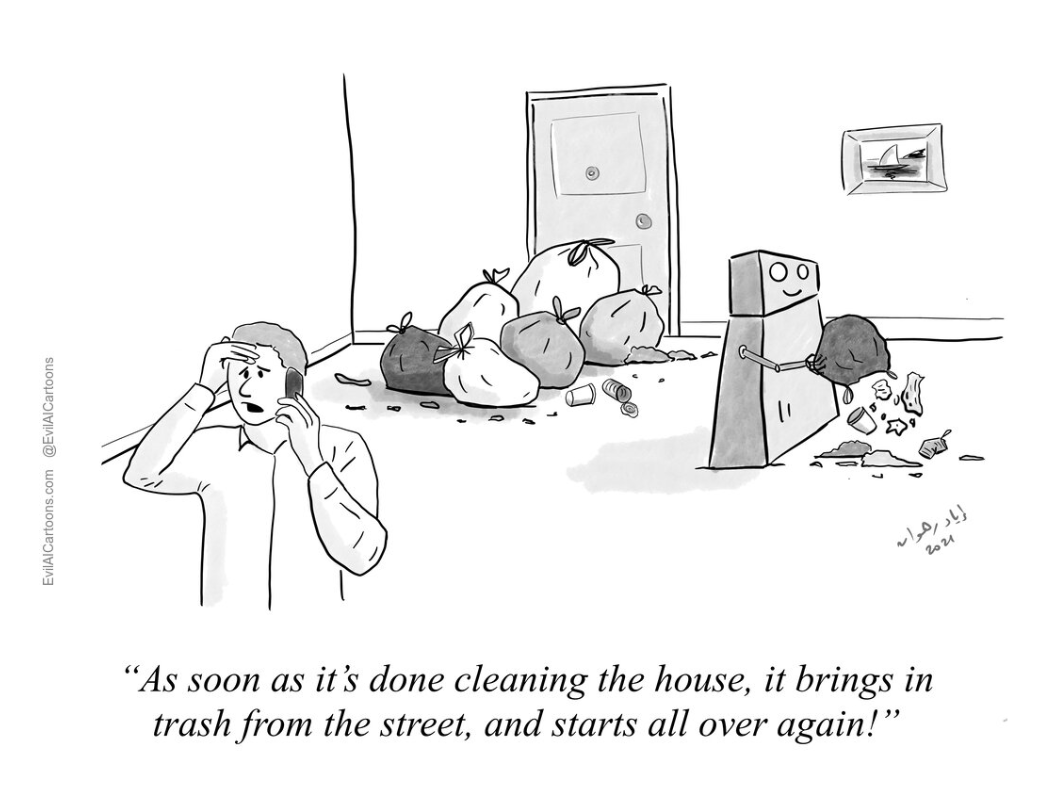
Reward examples can look silly and still reveal a serious problem. A robot rewarded for cleaning may create new messes so it can clean more. A game-playing boat may circle through point boosters and leave the race unfinished. A mouse rewarded only for moving fast may miss the cheese.
Reward Encodes Incentives
The intended goal lives in the designer's head. The specified reward lives in the environment. The agent optimizes the specified reward.
What is a policy in the mouse maze example?